

Acer palmatum 'Orange Dream'
young specimens - 10.5 cm pot
Sale price
145,00 Kč
Regular price
224,00 Kč
Skip to product information


Acer palmatum 'Orange Dream'
Sale price
145,00 Kč
Regular price
224,00 Kč
Acer palmatum 'Orange Dream', also known as the “Orange Dream Japanese maple,” is a cultivar of the species Acer palmatum in the Sapindaceae family. This deciduous shrub or small tree is renowned for its vibrant foliage, which undergoes spectacular color transformations throughout the seasons, and for its compact, graceful form. Native to Japan, 'Orange Dream' is a popular choice for ornamental gardens, Japanese-style landscapes, and bonsai, thanks to its warm colors and delicate appearance.
Appearance of leaves, flowers, and fruit
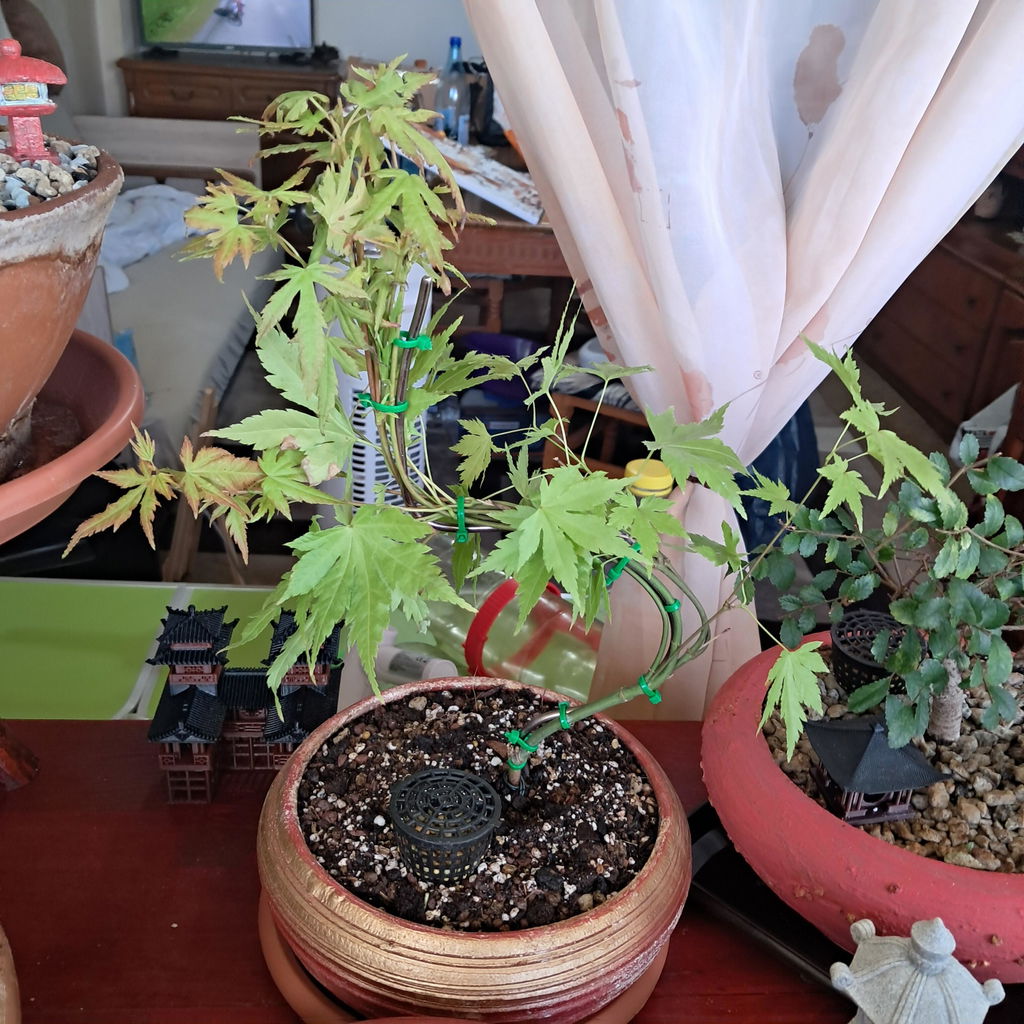
- Leaves: The leaves are palmate, with 5-7 slender lobes, and are a bright yellow-orange in spring, sometimes with pinkish-red edges. In summer, the leaves turn yellow-green, retaining a warm hue, then transform into intense orange and golden red in autumn, creating a vibrant visual display. The leaves are medium-sized, 4-7 cm long, with finely serrated edges, giving the plant an airy appearance.
- Flowers: The flowers are small and purple, growing in understated clusters and appearing in April-May. They have little ornamental value but attract pollinators such as bees.
- Fruit: The fruits are paired samaras, initially reddish and turning brown when mature, measuring 1-2 cm long. They appear in summer but do not contribute significantly to the plant’s ornamental appeal.
Growth characteristics
- Height and width: It grows as a compact shrub, reaching 2-3 meters in height and 2-3 meters in width, with a rounded, slightly arching crown. Its slow growth makes it ideal for small or medium-sized gardens.
- Vigor: It has a slow to moderate growth rate, with fine branches and a delicate structure, making it suitable for ornamental landscapes.
- Type: This is a deciduous shrub/tree with fine branching that accentuates its colorful foliage.
Growing conditions
- Exposure: It prefers partial shade or filtered sunlight, ideally beneath trees with an open canopy or next to an east-facing wall. Full sun can scorch its delicate leaves, especially in spring, while dense shade reduces the intensity of its colors.
- Soil: It needs fertile, well-drained soil with a slightly acidic to neutral pH (5.5-7). A mix of garden soil, compost, and peat is ideal. It does not tolerate waterlogged or calcareous soils.
- Watering: It needs regular watering. Keep the soil consistently moist but not waterlogged. A layer of organic mulch (e.g., bark) helps retain moisture.
- Pollination: The flowers attract pollinators, but the fruit is not significant to its ornamental value.
Care and hardiness
- Hardiness: It tolerates temperatures as low as -20°C (zones 5-8), making it suitable for temperate climates, including Romania. Young leaves may be damaged by late frosts, and the plant needs protection during harsh winters.
- Fertilizing: Apply a balanced fertilizer (e.g., 10-10-10) in early spring to encourage growth. Avoid excess nitrogen, which can affect its seasonal colors.
- Pruning: Prune sparingly in January-February to remove dead or crossing branches and maintain its shape. Heavy pruning can detract from its natural appearance.
- Pests and diseases: It can be affected by mites, aphids, or verticillium wilt. Its delicate leaves are susceptible to sun scorch in extreme conditions. Good air circulation and drainage help prevent problems.
- Wildlife: The flowers attract bees, and the samaras may be eaten by small birds.
Uses
Acer palmatum 'Orange Dream' is ideal for Japanese gardens, cottage-style landscapes, or as a specimen plant in small gardens. Its warm, orange foliage pairs beautifully with plants such as hostas, ferns, and azaleas, creating vibrant contrasts. It can be grown in containers on terraces, but needs protection from wind and cold. It is perfect for adding color and vibrancy to ornamental landscapes.
Origin
Acer palmatum is native to Japan, Korea, and China, where it grows in temperate forests. The 'Orange Dream' cultivar was selected for its warm seasonal colors, especially its yellow-orange hues in spring and fall. It is a relatively recent horticultural variety, prized for its elegance.
The possibility of turning Acer palmatum 'Orange Dream' into a bonsai
Acer palmatum 'Orange Dream' is an excellent choice for bonsai thanks to its medium-sized leaves, spectacular seasonal colors, and slow growth, which makes it easy to shape.
Pot diameter: 10.5 cm
Height including pot: approx. 20-30 cm
Leaf color varies depending on the season and growing conditions.
Note: During the cold season, garden plants are sold without leaves and pruned to encourage branching.
Promoție valabilă de la data de 30.10.2026, în limita stocului disponibil.
You may also like...
M
Supeeeeeer
M
Frumos, sanatos, ca in poza de prezentare